Strawberry jam is often the first preserve anyone attempts, and just as often the first to disappoint. Strawberries hold very little pectin and only modest acidity, so a low-sugar batch made without added pectin can drift from a soft set to a syrup while you're answering the door. The fix isn't a secret ingredient. It's a smaller batch, a wider pan, a little patience, and an honest set test. Do those four things and you get jam that tastes of strawberries and vanilla, not of sugar with a red tint.
Pectin is the natural gelling fiber in fruit, and strawberries rank near the bottom of the list. They're also low in acid, which pectin needs in order to form a gel. That leaves two levers: sugar and evaporation. Sugar doesn't only sweeten; it competes with water and helps the pectin strands bind. A workable range for no-pectin strawberry jam is roughly 55 to 65 percent sugar by weight of prepared fruit, so 1 kg of hulled strawberries wants about 600 to 700 g of sugar. Push much below that and you're making a very nice strawberry sauce that will also keep less well.
With no pectin packet to do the work, you cook longer and evaporate more water. That's why batch size matters. A kilo of fruit in a wide, heavy pan will reduce in 25 to 35 minutes. Three kilos in the same pan may take an hour, darken the fruit, and still set poorly. Keep it small: one to one and a half kilos of fruit per batch.
For a batch yielding three to four half-pint jars:
Equipment matters as much as ingredients. Use the widest, heaviest pan you own: a preserving pan, a wide sauté pan, or a Dutch oven. Surface area is what drives evaporation. You'll also want a wooden spoon or heatproof spatula, a potato masher, a saucer in the freezer, a jam thermometer if you have one, a ladle, and clean jars with new lids.
Drop a teaspoon of jam onto the frozen saucer and put it back in the freezer for a minute. Push the edge with your finger. If it wrinkles and holds a skin, it's ready. If it slides around like syrup, keep boiling and test again in three minutes. With a thermometer, aim for 104–105°C (219–221°F) at sea level. Water boils at a lower temperature as you climb, so subtract roughly one degree Celsius for every 300 meters above sea level.
One caution: jam is always looser when hot than when cold, so pull it just before you think you should. It will firm up further during its first week in the jar.
The base recipe takes kindly to company. Add these quantities to a 1 kg batch:
Keep added liquid to a minimum. Every extra spoonful is another few minutes of boiling and a slightly darker jam.
Ladle hot jam into hot jars, leaving about 1 cm (half an inch) of headspace. Wipe the rims with a damp cloth, apply the lids, and process in a boiling water bath. Ten minutes is typical for half-pint jars at sea level, adjusted for your altitude. If you're new to canning, follow a tested canning guide for your jar size and altitude rather than guessing. Alternatively, cool the jars and store them in the fridge or freezer.
Low-sugar jam doesn't keep as long as the commercial kind. Once opened, use it within three to four weeks and always with a clean spoon. If you see mold, fizzing, or a smell that's off, throw the jar out. A spoonful isn't worth the risk.
Write the date and the fruit weight on every label, and note how long the batch took to set. Two or three rounds in, you'll know your pan and your stove, and you'll stop needing the saucer test quite so often. Start with one kilo, keep the vanilla generous, and let the fruit, not the sugar, do the talking.
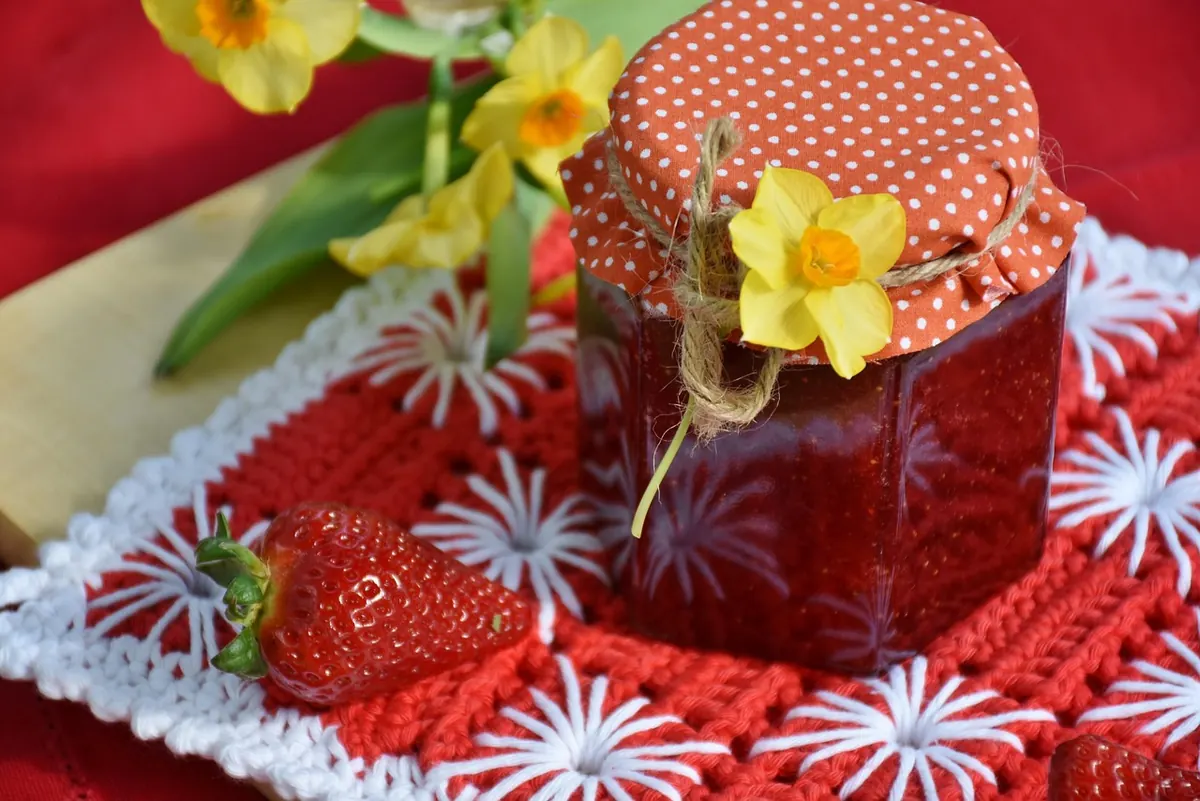
Photo: RitaE / Pixabay